Engineering
Solo-built the shop as one Astro application on Cloudflare Workers, with D1, R2, Paystack payments and Mailgun email.
Zingy Beddings sells by fabric, colour and bed size, and most orders used to start on WhatsApp. The shop had to handle all those choices and still take payment on its own.
Zingy Beddings is a bedding brand in Ikorodu, Lagos, selling bedsheets, duvets, duvet covers, pillowcases, pillows, mattress covers and throws. I designed and built its online shop on my own: a catalogue where every item is chosen by size, fabric and colour, a builder that puts a duvet set together piece by piece, checkout by Paystack or bank transfer with delivery or pickup, private order pages, returns, and an admin the owner runs from her phone. The whole system is one Astro application on Cloudflare Workers, with D1 for data and R2 for photos and payment proofs.
Solo-built the shop as one Astro application on Cloudflare Workers, with D1, R2, Paystack payments and Mailgun email.
Designed the catalogue around size, fabric and colour choices, with a duvet set builder that prices the set as the customer chooses.
Took the shop from first commit to a live custom domain, with a preview environment and an admin the owner runs without a developer.
Most shop templates assume a fixed list of products with a photo and a price each. Zingy makes bedding to order, so the same sheet can be six sizes, five fabrics and dozens of colours, and the price depends on what the customer picks.
A customer doesn't buy “a bedsheet”. They buy a queen-size bedsheet in Korean cotton in sage. Listing every combination as its own product would have meant hundreds of near-identical pages, and a price list nobody could keep correct.
Duvet sets made it harder. A set is a duvet, pillowcases, and optionally a bedsheet, a duvet cover and a mattress cover, each in its own fabric and colour. Customers needed to see one clear price for the whole set while they were still choosing.
Zingy's customers were used to sending a message, asking a question and paying by bank transfer. A checkout that only took cards and hid the phone number would have lost the people who trust a conversation more than a form, and pushed every transfer payment back into a chat where the shop had no record of it.
The shop also had to work for requests it couldn't predict: a custom size, a colour that isn't in the palette, a fabric that is out of stock this week. Those needed somewhere to go other than a dead end.
The business is run by its founder, mostly from a phone. She needed to add products, change prices, see orders, confirm payments, handle returns, answer messages and issue receipts without a laptop and without calling a developer.
Sales also happen outside the website, in person, on WhatsApp and by bank transfer. The records for those needed to live in the same place as the website orders, with receipts that look the same whichever way the customer paid.
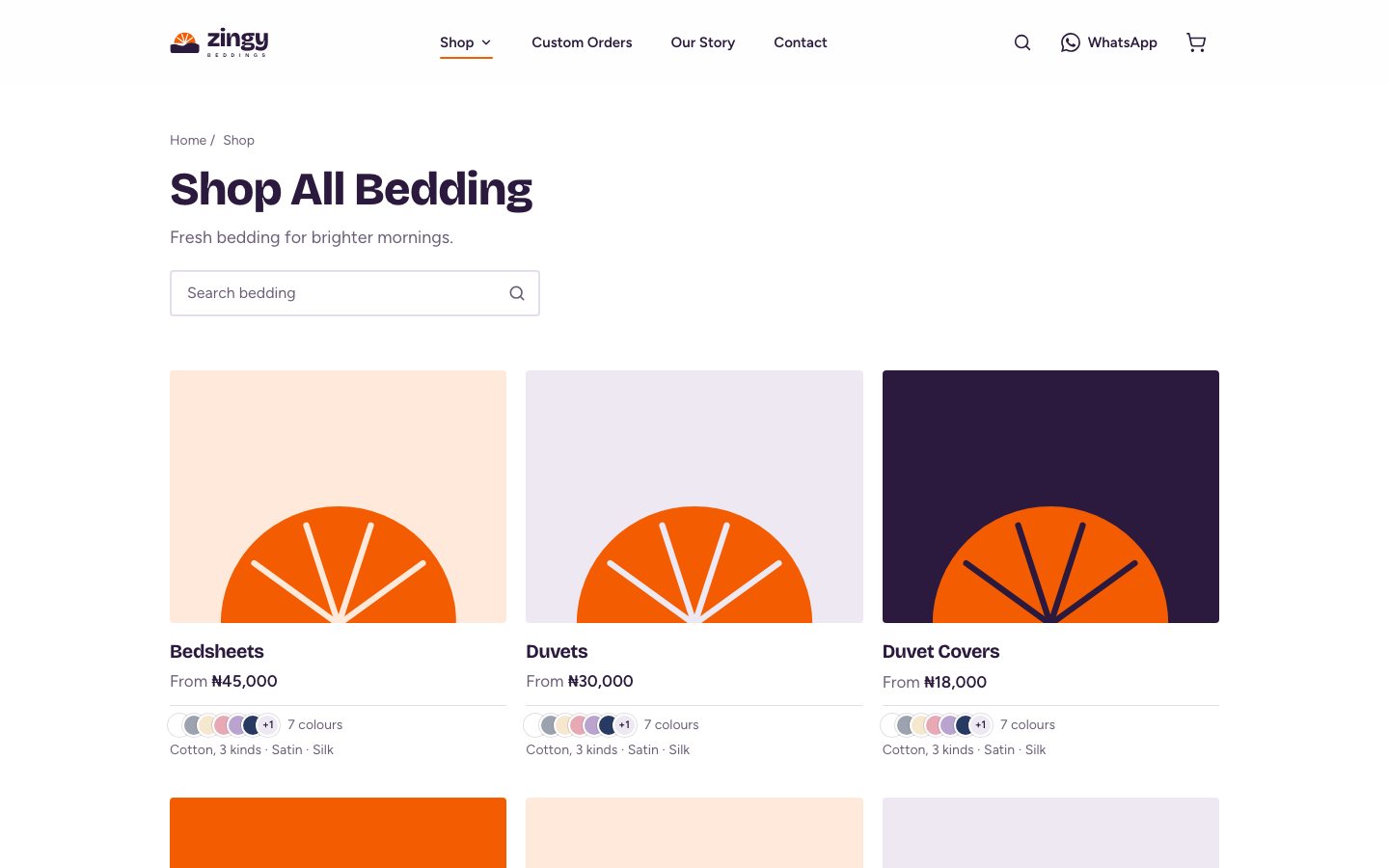
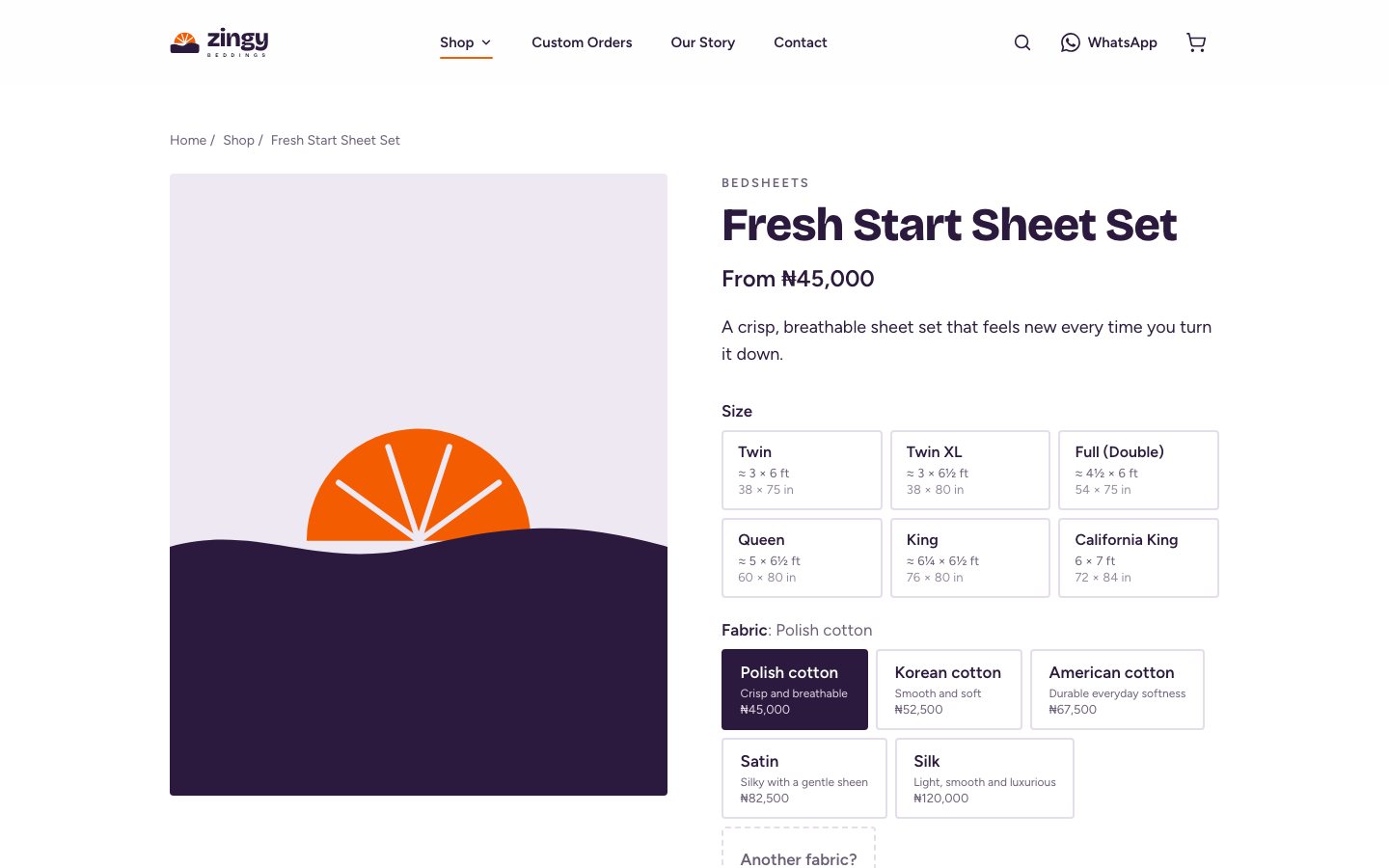
The shop shows categories first. Each category has one product page where the customer picks a bed size, then a fabric, then a colour from a palette. Prices read “From ₦45,000” at the cheapest option in stock and narrow to an exact figure as choices are made. Bed sizes are shown with their measurements in feet and inches, with a size guide one tap away.
Not every product is chosen the same way. Some have no bed size and others come in a single fabric, so each product records exactly which options it comes in, and its page asks only those questions. A product with no options at all is a single price and a single stock count. An earlier version kept this setting on the category, which meant two places to keep in step. Moving it onto the product removed that whole class of mismatch.
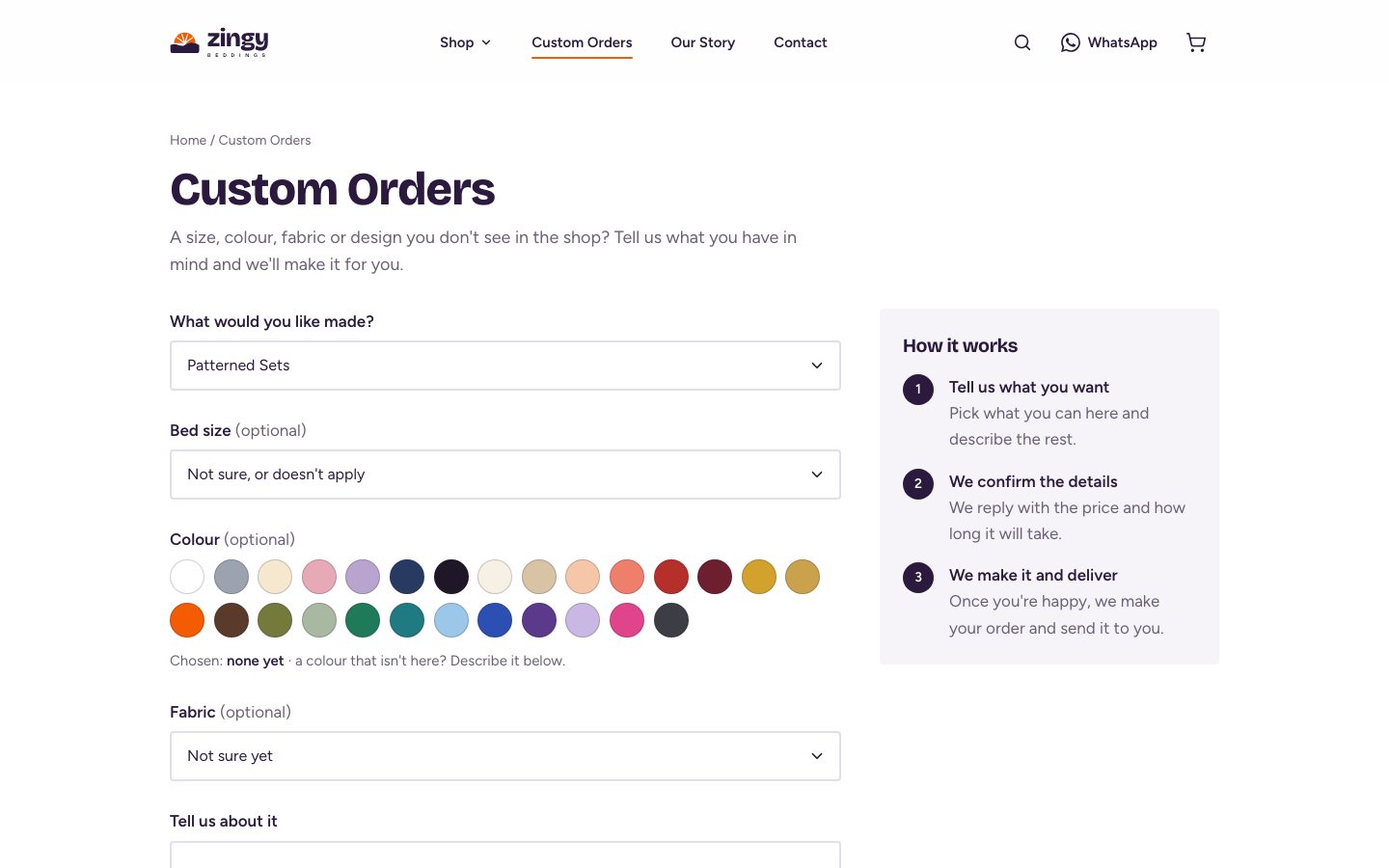
Choices that aren't available are still shown, with a way to request them. A Custom Orders page takes anything else, such as a custom size, a colour that isn't listed or a design of the customer's own, and explains what happens after they send it.
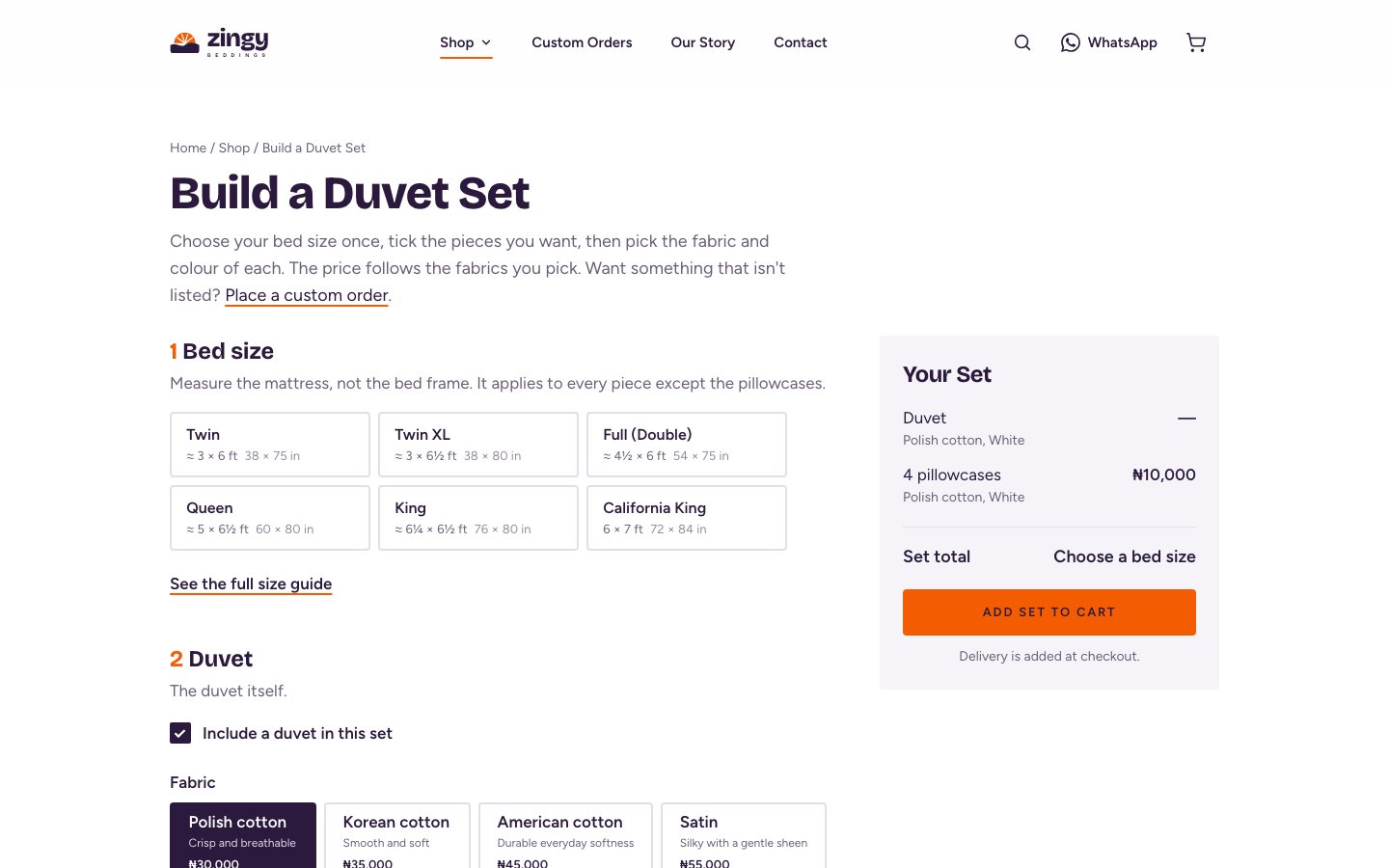
The duvet set builder asks for the bed size once, then lets the customer tick the pieces they want and pick a fabric and colour for each, including a different one for each pair of pillowcases. A summary panel stays beside the form and updates the set total after every choice.
In the cart a set counts as one item and can be reopened and edited. The owner controls the prices behind it from the admin, so a fabric price change doesn't need a code change. Because the builder reads the same options as the product pages, the admin warns before a change that would remove an option the set depends on.
The cart is an HttpOnly cookie holding only product IDs, options and quantities. Prices are recalculated from the database on every page, so nothing a customer edits in their browser can change what they pay. Checkout offers delivery by zone, with Lagos split into Mainland and Island and a landmark field alongside the address, or pickup from the shop.
Card payment goes through Paystack's hosted checkout, so no card details touch the site. When the customer returns, the payment is verified with Paystack's API and the amount and currency must match before the order is marked paid. The webhook does the same check with an HMAC-SHA512 signature, so an order is still confirmed if the customer closes the tab. Marking an order paid is idempotent, reduces stock and emails both the customer and the shop.
On a phone, the subtotal and the checkout button stay in a bar at the bottom of the cart until the order summary's own button scrolls into view. Form errors look the same across the shop and the admin. A box at the top lists what went wrong, each line jumps to its field, and the field itself is marked.
Many customers prefer to pay by transfer, so checkout offers it beside Paystack. The customer places the order, pays into one of the shop's accounts, and uploads proof of payment on their order page. The owner sees the proof on the order in the admin and either confirms it or declines it with a reason, in which case the customer can upload again.
Confirming a transfer calls the same idempotent paid-order function as a verified Paystack payment, so stock, emails and receipts behave identically whichever way the money arrived. Uploading and declining a proof are conditional database updates that only succeed from the expected state, so a double tap or two open tabs can't confirm an order twice or overwrite a proof that is already waiting for review.
Proofs are treated as untrusted uploads. The file type is read from the first bytes of the file, not from its name or the type the browser claims, only images and PDFs up to 6 MB are accepted, and proofs are stored privately and shown only inside the admin. The bank accounts themselves are edited in settings, so changing banks is not a code change.
An order page shows a name, an email address and a delivery address. The order number can't be what protects it, because the number is quoted on the phone, at pickup and in bank transfer descriptions. Each order therefore carries its own long random key. The links in order emails include it, and the browser that placed the order is remembered in an HttpOnly cookie.
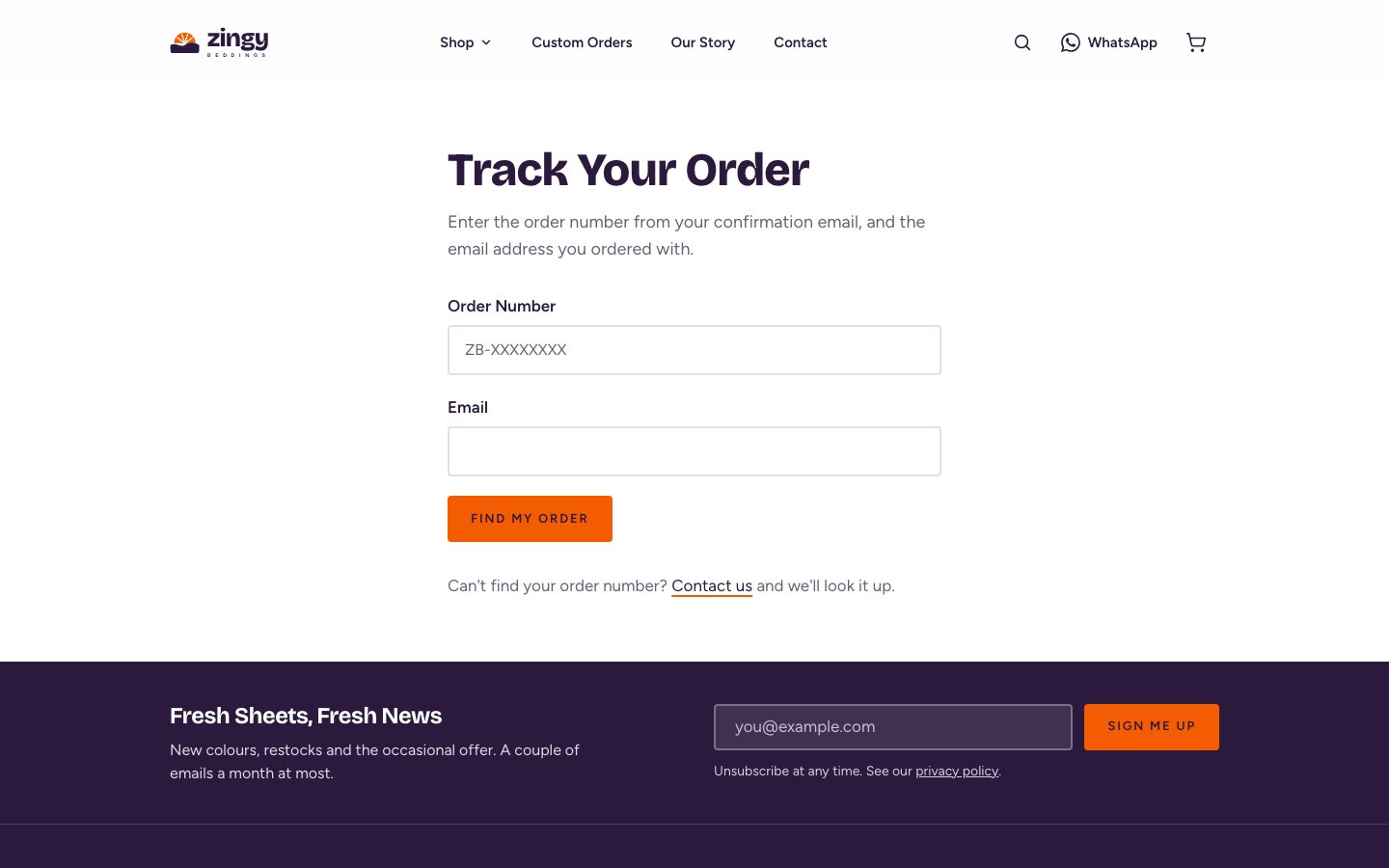
Anyone else is sent to the Track page, which asks for the order number and the email address together. It runs a Cloudflare Turnstile check before looking anything up, so a script can't try one email after another against a known order number, and the error never says which of the two was wrong.
WhatsApp remains a first-class way to order. It sits in the header on every page, and the cart and checkout both offer “order on WhatsApp” with the contents of the cart already typed into the message, so the shop still receives a complete order from customers who prefer a conversation.
The admin has a phone-first layout and covers the whole business. Each product has one prices and options page: what it comes in, a colour picker with shades, and a price and stock level for every option, in tables that follow what is ticked. Changes that would remove options or affect the duvet set are spelt out before they are saved, and destructive actions such as voiding, cancelling or repricing go through a confirmation prompt.
Orders show payment, delivery and items in separate cards, with counts on each status tab. Pickup orders move through “ready for pickup” and “collected”. Returns are recorded on the order they belong to, tracked beside its status, and can email the customer at each step. Delivery fees are set per state from a list, with a summary of which customers are offered which option.
A receipt generator issues branded receipts for any sale, whether it came from the website, a walk-in, WhatsApp or a bank transfer. Receipts are numbered per year, show the amount in words, and can be printed, emailed or sent on WhatsApp with a private link. A receipt can be voided with a reason but never deleted, so the numbering stays complete for the books. The owner can also edit the site's wording, FAQs, phone numbers and social links, and write and send newsletters, without touching code.
The admin sits behind Cloudflare Access with a one-time code by email, and the application verifies the Access token again in code against an email allow-list, so a misconfigured Access policy alone can't open it. Every form has an origin check and all SQL is parameterised. Every public form that writes to the database or sends an email, including checkout, contact, order tracking, newsletter sign-up and product requests, passes a Cloudflare Turnstile check, and the Turnstile script only loads once someone starts on the form.
Uploaded photos are stored as the type their bytes say they are, so a file that is only labelled as an image is never served as one. The site ships with a strict Content Security Policy and HSTS, repeats its security headers on static files that bypass the application, redirects plain http to https, and tells browsers never to store pages that carry a customer's own details. The preview environment shares the live database, so it runs read-only and refuses every request that isn't a GET.
Pages are server-rendered with unique titles, canonical URLs, a sitemap that includes every product, and structured data for the store, products, breadcrumbs and FAQs. Fonts are self-hosted and subset. The delivery, returns, privacy and terms pages are written out in full for Nigerian data protection and consumer law.
Every visitor sees the same catalogue, so the public pages read products, options, categories and delivery areas from a shared copy kept for five minutes in the Worker's memory and in Cloudflare's cache. Ordinary traffic, or a bot crawling the shop, no longer uses up the database's daily read allowance.
Any change in the admin and any paid order moves the catalogue's version on, so older copies are ignored and the shop shows the new price, photo or stock level. The admin and anything that submits a form always read straight from the database, so the cart and checkout work from fresh prices and stock.
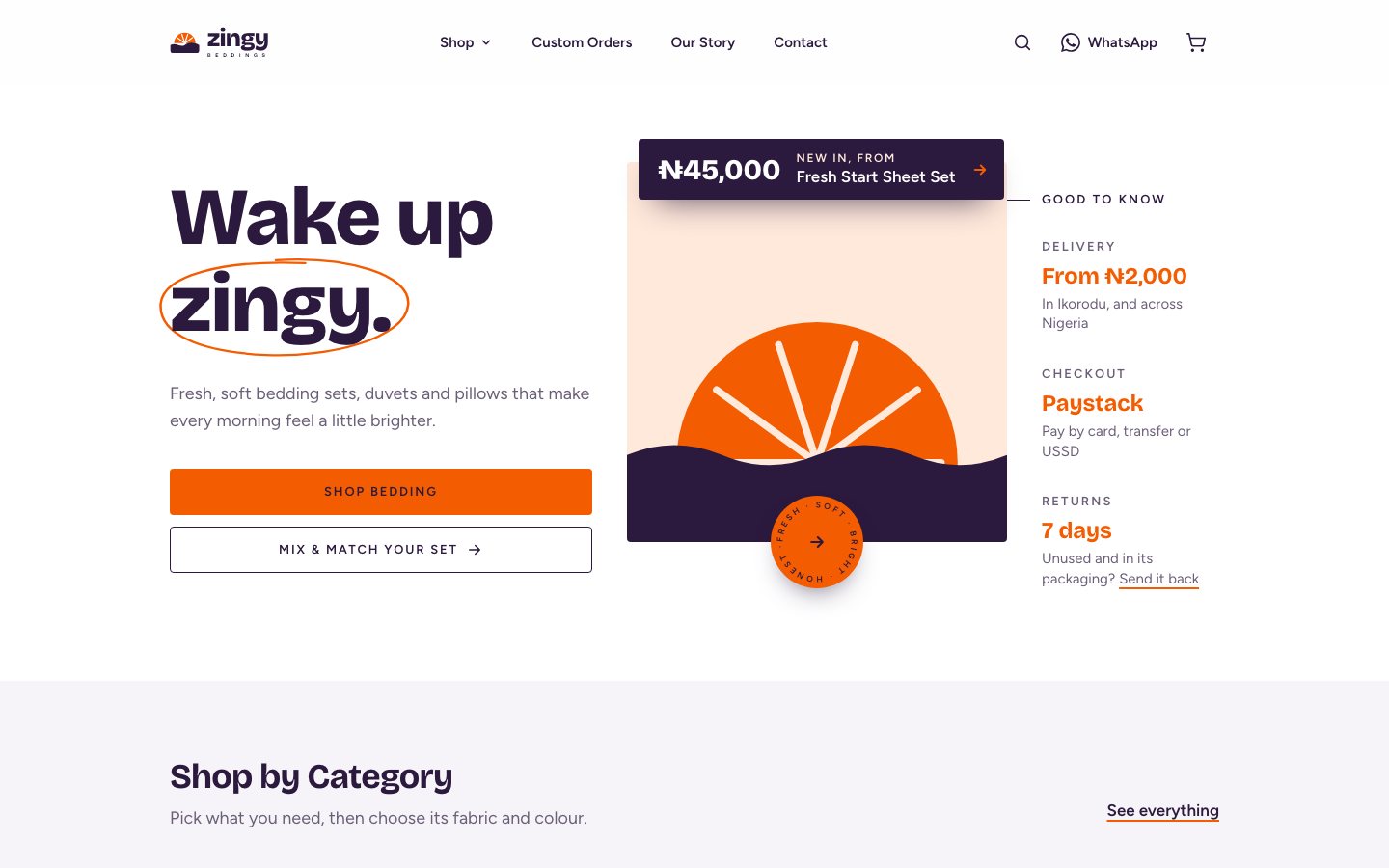
The shop turns a long list of sizes, fabrics and colours into three short questions. A customer can go from the home page to a priced, paid order for exactly the bedding they want without sending a single message.
The duvet set builder does the arithmetic that used to happen in a chat. The customer sees what each fabric costs and what the set comes to before they commit.
Products, options, prices, photos, delivery fees, bank accounts, FAQs, page wording and newsletters are all edited in the admin, from a phone. Changing a price or adding a colour is a few taps, not a request to a developer.
Website orders and offline sales share one set of records and one receipt format, and returns live on the order they came from, so the books are complete whichever way a customer paid.
A card payment is only marked paid after the amount and currency are verified with Paystack on the server, and the webhook confirms it again independently. A bank transfer is only marked paid after the owner has reviewed the proof. Both end in the same function, so a closed tab, a dropped connection, a repeated webhook or a double tap can't lose an order or count it twice.
Everything runs as one Worker with a database and a storage bucket. There are no servers to patch and very little to go wrong for a business with no technical staff.
A premium braiding hair catalogue with WhatsApp ordering and an owner-run admin that publishes catalogue changes live from Cloudflare R2.
Read Case StudyA solo-built property discovery platform with real-time chat, inspection booking, and a secure admin dashboard on Cloudflare Workers.
Read Case StudyBrand identity, design and a fast, accessible pre-rendered website for a new home care provider in Greater Manchester.
Read Case StudyIf you need someone who can manage the build, own the product decisions, and write content that actually gets found, let's talk.