Engineering
Built the React storefront and an owner admin that publishes the catalogue live through Cloudflare Pages Functions and R2, with no database and no rebuild.
DG Luxe sells through conversation. The site had to make every WhatsApp order arrive complete, and let the owner change styles, prices and photos without waiting for a deployment.
DG Luxe Co. sells premium braiding hair in a range of styles, lengths and colours. I built its storefront in React and launched it as a static catalogue that turns a customer’s selection into a ready-to-send WhatsApp order. I then redesigned the site on an editorial grid, gave every style its own page, and added a hair guide and policy pages. The largest change is behind the storefront: an admin dashboard where the owner edits the catalogue, prices, colours and home page photo and publishes them live, served by Cloudflare Pages Functions and R2 with no database and no rebuild. I also shaped the product journey and managed delivery through launch.
Built the React storefront and an owner admin that publishes the catalogue live through Cloudflare Pages Functions and R2, with no database and no rebuild.
Structured product discovery and designed the style, length and colour-aware WhatsApp journey.
Managed scope, client communication, implementation, and production handover.
DG Luxe needed a storefront that matched the quality of its product and fitted the way its customers already buy. After launch, a second problem became the bigger one: every change to the catalogue was a code change.
Braiding hair is chosen by appearance, texture, length and colour. A plain product list would not have communicated the quality the brand wanted customers to associate with every bundle.
The site had to feel considered at every point of contact, from typography and colour to photography and the wording of each call to action.
Customers usually want help choosing a style, a length, a colour and a quantity, and delivery cost depends on where they are. A conventional checkout would have automated decisions the business still makes better in person.
The right product decision was to keep WhatsApp as the place where orders are confirmed and paid, and to make each conversation start with everything the business needs to know.
The first version kept styles, lengths and photos in a data file. That kept the site fast and cheap to run, but adding a style, replacing a photo or changing a price meant asking a developer and waiting for a build.
Stock and pricing change too often for that. The owner needed to make those changes directly and see them live straight away, without the site taking on the cost and upkeep of a commerce platform it didn't otherwise need.
Most of DG Luxe's traffic arrives from links shared on WhatsApp, Instagram and TikTok. The apps that build those link previews don't run JavaScript, so a single-page application shows the same generic preview for every link.
Once each style had its own page, each page needed its own title, description and photo in the HTML the server sends, and those had to stay correct for styles the owner adds after the last build.
I rebuilt the interface on a visible hairline grid: thin rules divide each page into cells, the way a printed lookbook is laid out. Cormorant sets the headlines, Jost sets the body text, and the palette is burgundy on cream with a rose accent. The design carries the brand through type, spacing and photography, with very little decoration.
The site grew from four pages to a full storefront: home, shop, a page per style, a hair guide, delivery and returns, privacy, terms, about and contact. It is responsive from 390 pixels wide, keeps visible keyboard focus, and turns off non-essential motion for visitors who ask for reduced motion.
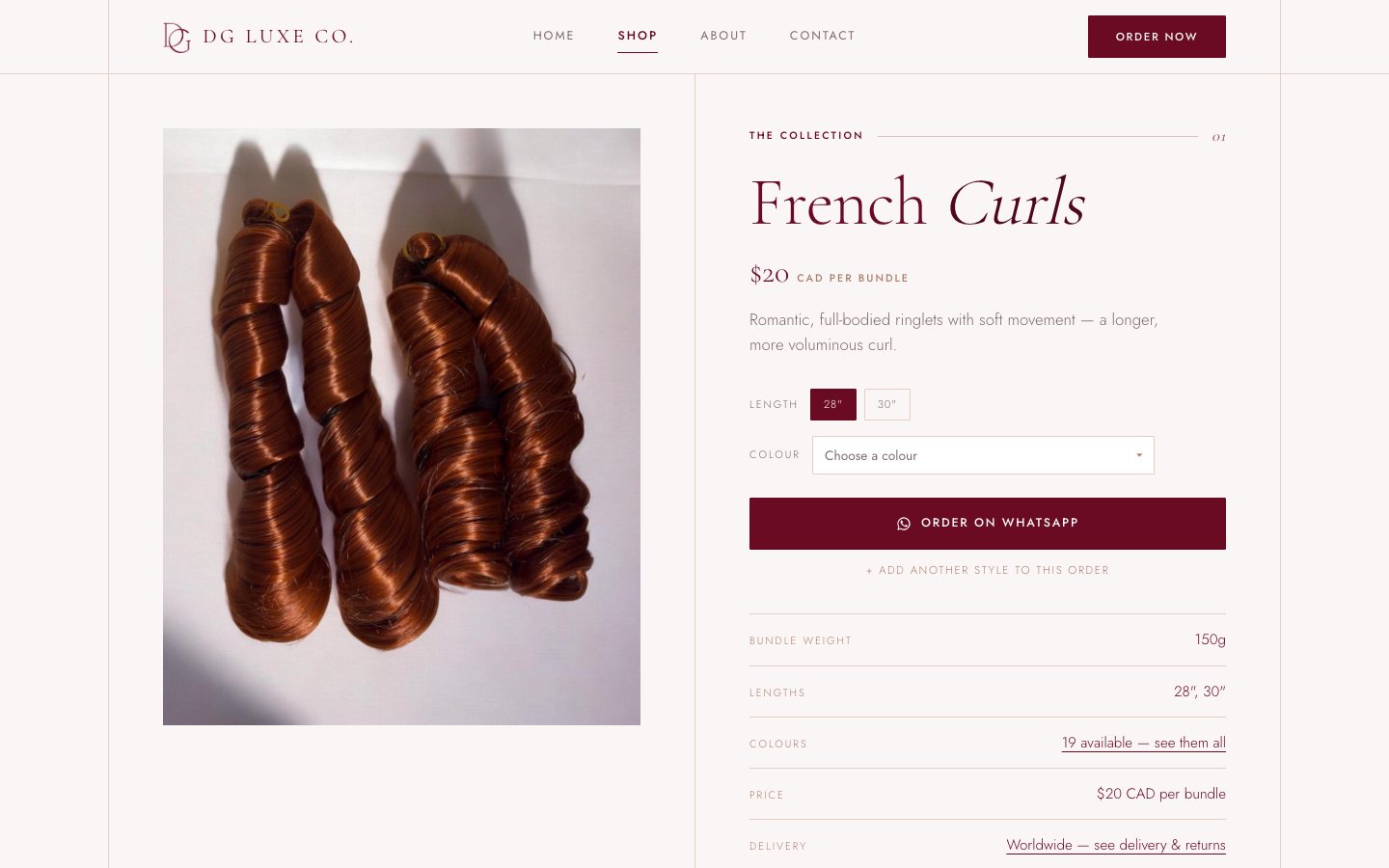
Every style has its own address and page showing its price per bundle, bundle weight, lengths and the colours it can be ordered in. Choosing a length swaps the photo when a photo for that length exists. The price is set per style by the owner. If a style has no price set, the page says the price is confirmed in the chat instead of showing zero.
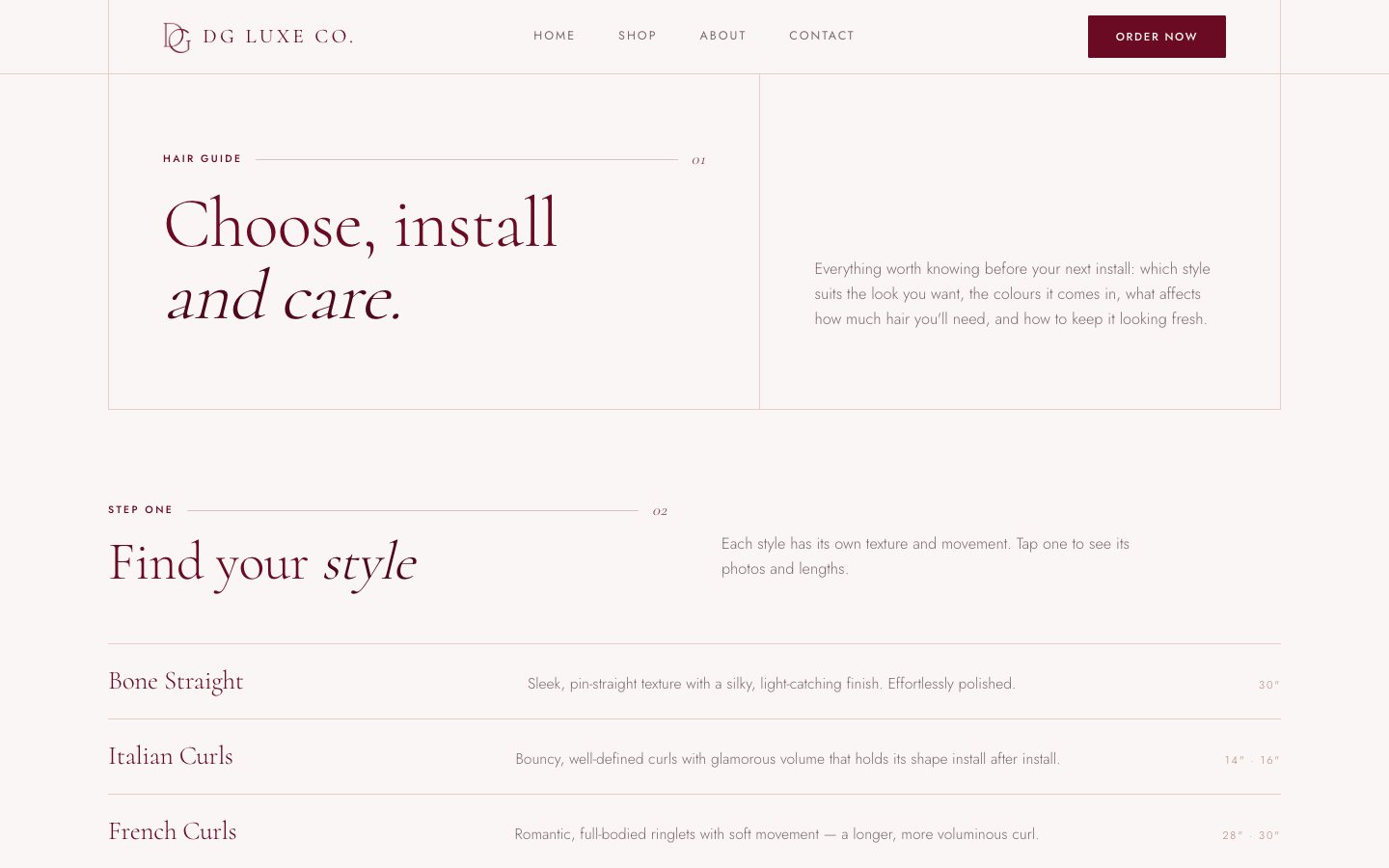
The Hair Guide answers the questions that used to open most conversations: which style suits a look, what affects how much hair an install needs, how to prepare, and how to care for it afterwards. Its style list is read from the same catalogue as the shop, so the guide can't go out of date when a style is added or removed.
Every order button builds a WhatsApp message containing the selected style, length and colour. Each entry point on the site sends a different prefilled message, so the reply already tells the business which page the customer was on and what they were trying to do.
Customers can add several style, length and colour combinations to an order tray that follows them across pages. The site combines them into one structured message, which removes the repeated questions from multi-item orders. No payment is taken on the site by design. Price, delivery and payment are confirmed in the chat.
The owner signs in at /admin and works across four pages: the catalogue, the home page photo, the list of colours, and the password. Edits are held as one draft that carries across those pages, and a single Publish makes all of them live. Styles can be added, edited, removed and reordered, each with a price, lengths and a photo per length.
The catalogue is a single JSON document in Cloudflare R2, not a database. For one editor and a few dozen styles, a database would add a schema, migrations and a query layer to store one small document that is always read whole. Publishing writes the new document, and the next page request serves it. Nothing is rebuilt.
Photos are resized in the browser before upload, to a longest edge of 1,400 pixels and under 1.5 MB, so a 10 MB phone photo never leaves the phone at full size. The admin is a separate bundle that loads only on /admin, so shoppers download none of it.
The server never trusts what the dashboard sends. Every publish is validated in full: required text, length limits, price ranges, duplicate colours, and photo paths that must match the two places a photo is allowed to live.
Publishing uses optimistic concurrency. The dashboard sends back the version it started from, and the write to R2 is conditional on that version still being current. If the catalogue was changed from another device in the meantime, the publish is rejected with a clear message instead of silently overwriting the other edit.
The order of writes is deliberate. New photos are stored first, under names derived from their contents, so a publish that fails halfway leaves nothing broken. The previous catalogue is copied into a history folder before it is replaced, and the most recent 30 versions are kept. Photos that are no longer referenced are removed afterwards, and a failure in that cleanup doesn't undo a successful publish.
The storefront is still a static React build. A Cloudflare Pages Function runs in front of every page, reads the catalogue from R2, and inlines it into the HTML as the response streams, so the page renders the current styles on first paint with no loading state and no extra request. If R2 can't be read, the page is served untouched and the app uses the catalogue it was built with. The shop stays up either way.
The same function rewrites the title, description, canonical URL and Open Graph tags for style, guide and policy pages, so a link to French Curls shared on WhatsApp shows French Curls. The sitemap is generated on request from the live catalogue, so a new style is discoverable without a deployment.
I chose this over moving the site to a server-rendered framework. It gave crawlers and link previews correct HTML, and gave shoppers live data, while leaving the existing storefront code and its static hosting as they were.
Sign-in is an email address from an allow-list and a password. The password starts as a deployment secret. Once the owner changes it from the dashboard, only a salted PBKDF2 hash is stored. Credentials are compared in constant time, and both the email and the password are always checked, so neither the response nor its timing reveals which one was wrong.
A session is an HMAC-signed, HttpOnly, SameSite=Strict cookie that expires after twelve hours, with no session table to maintain. The signing key is derived from the current password, so changing the password signs out every other device. Five failed attempts from one network address within fifteen minutes pause sign-in from that address for fifteen minutes. The admin API accepts changes only as JSON from the site's own origin.
Every response carries HSTS, a no-framing rule and a Content Security Policy. The policy allows the one inline script that carries the catalogue through a per-request nonce and blocks any other. The per-address lockout can't stop guessing that is spread across many addresses, and the documented next step if that ever matters is to put the admin behind Cloudflare Access.
Adding a style, changing a price, replacing a photo or updating the colour list is now done by the owner and is live as soon as it is published. None of it needs a developer or a deployment.
The safeguards are sized to the risk. Validation, conflict detection and thirty kept versions mean a mistake can be caught or rolled back, without the weight of a full content management system. Rolling back is still a manual copy in the storage bucket. A restore button is the next thing I would add.
A customer can discover the brand, compare styles, choose a length and colour, and open a WhatsApp conversation that already says what they want and where they came from.
The order tray supports customers considering several products, turning multiple selections into one organised message for the DG Luxe team.
DG Luxe is no longer limited to a social profile or a message thread. Each style has an address that can be indexed, linked and shared, with its own title, description and photo in the link preview.
Because the previews and the sitemap are produced from the live catalogue, a style the owner adds today is shareable and discoverable today.
The site has no payment gateway, no customer accounts and no database, because the business doesn't need them yet. It is a static storefront, a storage bucket and a small set of edge functions, which keeps running costs and upkeep close to zero.
Each of those choices is reversible. Prices are already in the catalogue, product pages already exist, and the admin already has authentication, so a checkout can be added later without rebuilding what is there.
“Element made the entire process straightforward and stress-free. Communication was clear, every deadline was met, and the quality of the final work exceeded my expectations.”




A made-to-order bedding shop with a duvet set builder, Paystack and bank transfer checkout, and a phone-first admin on Cloudflare Workers.
Read Case StudyA complete digital platform for a Nigerian eye health nonprofit, including programmes, donations, volunteering, stories, secure forms, and SEO content.
Read Case StudyA solo-built property discovery platform with real-time chat, inspection booking, and a secure admin dashboard on Cloudflare Workers.
Read Case StudyIf you need someone who can manage the build, own the product decisions, and write content that actually gets found, let's talk.